Altcoin Index Trading & Charts
How spot benchmarks, charting, perps, funding, leverage, exchanges, brokerage accounts, wallets, and custody change the implementation.
Label the series before reading the line
A chart can show a spot price index, total return, equal-weight breadth, market-cap performance, a back test, a futures series, or a collateralized perpetual strategy. Those lines answer different questions. Every chart should identify the reference currency, timezone, observation frequency, constituent rules, return type, and whether data are live or hypothetical.
Normalized charts improve comparison
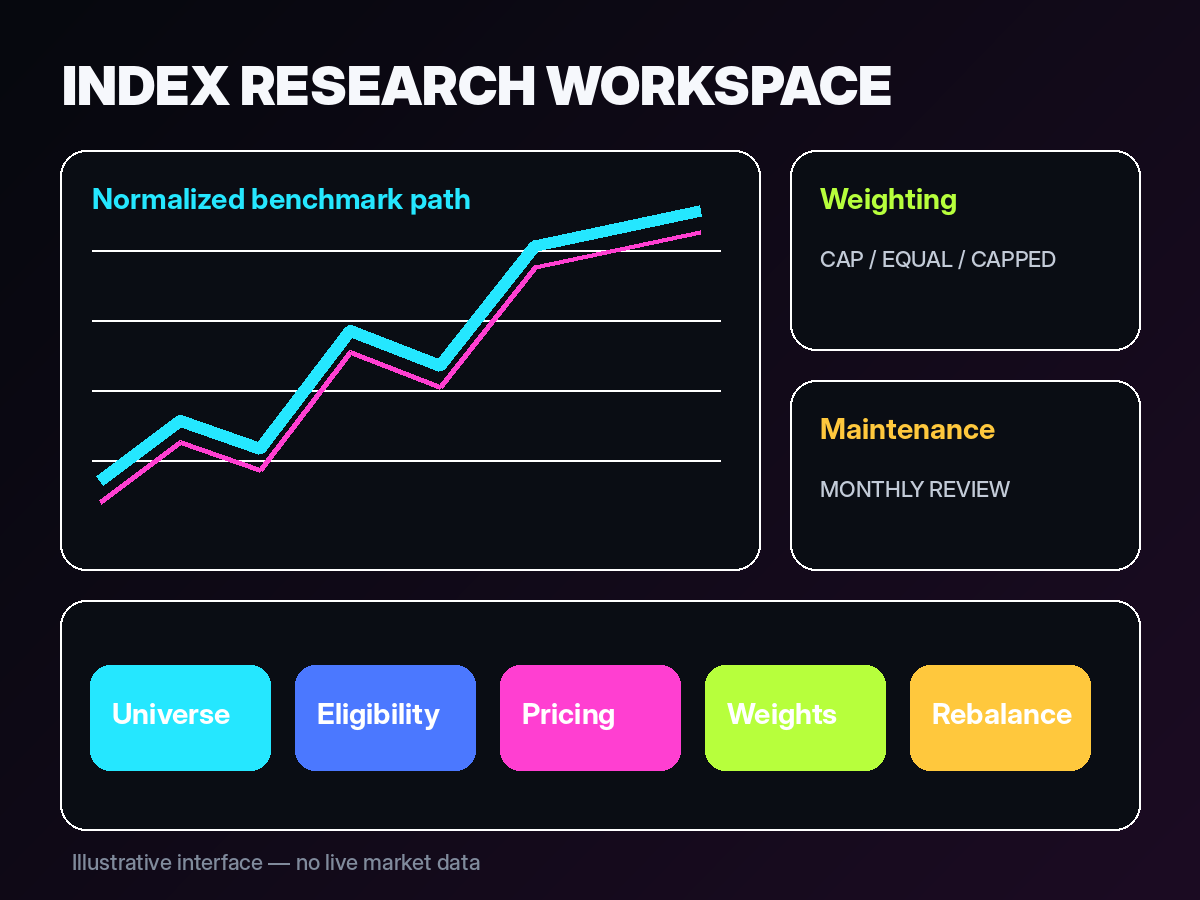
Setting several series to the same starting value makes relative movement visible, but it can hide the absolute size, volatility, and liquidity of each market. Pair normalized performance with drawdown, concentration, turnover, and coverage panels.
A perps index adds a derivatives layer.
Spot and mark prices
Document eligible spot venues, quote conversion, outlier controls, and the venue-specific mark used for margin.
Positioning cost
Specify funding times, compounding, long or short direction, and whether the series is price-only or includes payments.
Path-dependent risk
State target notional, collateral, haircuts, margin rules, liquidation assumptions, and contract-replacement policy.
Venue due diligence
Coinbase, Binance, Robinhood, traditional brokerage firms, decentralized protocols, and regional exchanges represent different access models. Product availability and legal status vary by location. Compare the actual legal entity and account terms rather than the brand name alone.
- Constituent and network coverage
- Order-book depth, spreads, and reference prices
- Asset segregation and custody structure
- Deposits, withdrawals, transfer limits, and migration support
- Fees, funding, interest, and collateral terms
- Jurisdictional access and dispute process
Brokerage account versus wallet
A brokerage product can simplify reporting and operations while adding product, issuer, and tracking risk. A centralized exchange can offer direct token access while concentrating custody and execution. A self-custody wallet provides direct authorization while shifting key management, network selection, backups, and recovery to the holder. A smart-contract wallet can add policy controls and contract risk.
The venue and custody guide uses a decision matrix covering benchmark coverage, custody, liquidity, cost, token events, security, reporting, and exit planning.