Altcoin Index Methodology
A transparent framework for benchmark objectives, eligibility screens, pricing, weighting, rebalancing, governance, and publication.
Design the benchmark before testing performance
A methodology should be defensible without knowing which historical variant produced the strongest return. Begin with the market-coverage objective and intended use. Then choose data and rules that match it. This order reduces hindsight bias and keeps the benchmark from becoming an optimized back test.
1. Objective and scope
State the asset class, exclusions, reference currency, return type, target audience, and whether the index is descriptive or intended to support an investable product.
2. Eligible universe
Define durable asset identifiers, native versus wrapped assets, minimum history, trading venue requirements, liquidity, supply data, custody support, and treatment of stablecoins, tokenized assets, privacy assets, and exchange tokens.
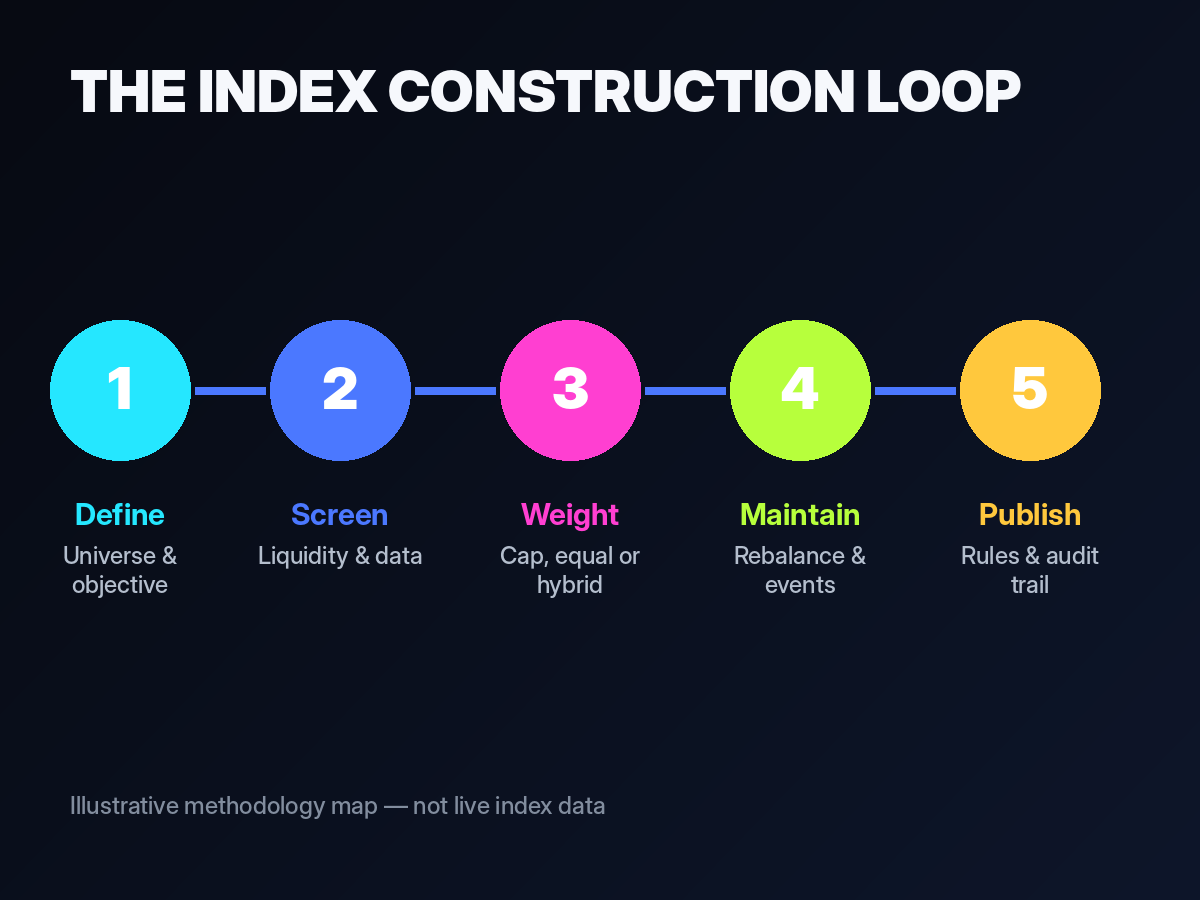
Every formula needs an operating rule.
Reference markets
Publish eligible venues, quote conversion, calculation windows, stale-price tests, outlier handling, and disruption fallbacks.
Investable units
Identify circulating or free-float sources, update timing, locked allocations, burns, bridges, and dispute handling.
Economic intent
Choose cap, equal, capped, liquidity-adjusted, fundamental, or hybrid weights and disclose every cap-redistribution step.
3. Reconstitution and rebalancing
Reconstitution changes membership. Rebalancing resets weights. Publish the observation date, announcement date, reference date, effective date, review cadence, entry and exit buffers, turnover controls, and fast-entry or fast-exit criteria.
4. Digital-asset events
Prepare treatments for migrations, forks, airdrops, redenominations, network halts, delistings, failed prices, staking distributions, maturities, and stablecoin depegs. Automatic rules should cover common events; committee discretion should be narrow and documented.
5. Governance and change control
Version the methodology, publish material changes before they take effect where possible, record committee decisions, preserve data files, and distinguish methodology changes from routine maintenance.
6. Validation and publication
- Recalculate the history independently.
- Check weights sum to 100% after every cap.
- Measure turnover, concentration, and coverage.
- Identify live, hypothetical, and back-tested periods.
- Publish constituent and change files with effective dates.
- Keep visible dates aligned with structured data, RSS, and sitemap records.
Continue with the long-form guides to build a broad-market index and design maintenance rules.